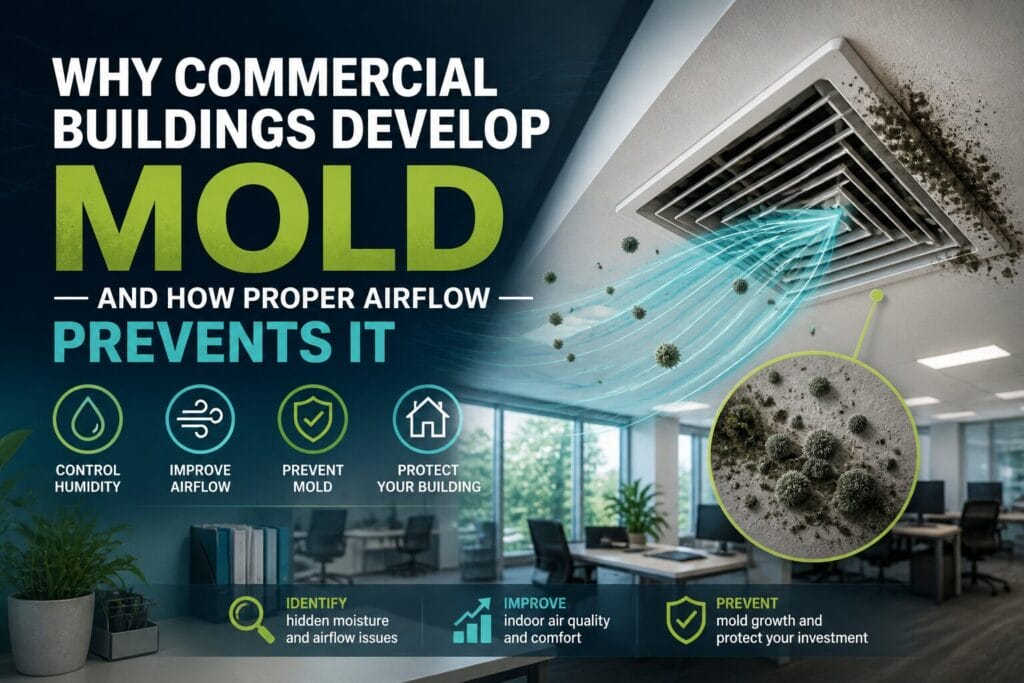
Mold problems in commercial buildings rarely start with visible water damage.
In many cases, the real cause is hidden inside the HVAC and ventilation system: poor airflow.
When air doesn’t circulate properly, moisture builds up. Over time, that trapped humidity creates the perfect environment for mold growth.
In this guide, you’ll learn:
- Why mold develops in buildings
- How airflow and ventilation affect moisture
- Common signs of hidden mold issues
- How HVAC systems contribute to mold growth
- How Steira Air helps prevent indoor moisture problems
What Causes Mold in Commercial Buildings?
Direct Answer:
Mold develops when moisture accumulates in areas with poor airflow and limited ventilation, allowing spores to grow on surfaces over time.
Mold only needs three things to grow:
- Moisture
- Organic material (dust, drywall, insulation, etc.)
- Limited airflow
Commercial buildings often create these conditions unintentionally.
How Does Poor Airflow Cause Mold?
Airflow helps regulate humidity and remove moisture from indoor spaces.
When airflow is restricted:
- Humidity increases
- Condensation forms
- Damp areas remain wet longer
- Air becomes stagnant
This creates ideal conditions for mold growth behind walls, above ceilings, inside ducts, and around HVAC components.
Why Ventilation Matters for Moisture Control
Quick Answer:
Proper ventilation removes humid indoor air and replaces it with fresh air, helping maintain balanced moisture levels throughout the building.
Ventilation systems are designed to:
- Control humidity
- Prevent condensation
- Improve air circulation
- Remove stale air
Without proper ventilation, moisture becomes trapped indoors.
According to the Environmental Protection Agency, excess indoor moisture is one of the primary contributors to mold growth in buildings.
Common Signs of Mold Caused by Airflow Problems
Many mold issues begin long before visible growth appears.
Early Warning Signs:
- Musty odors
- Condensation on windows or vents
- Uneven humidity levels
- Stuffy indoor air
- Water stains near vents or ceilings
- Increased allergy symptoms indoors
If these signs are ignored, mold can spread throughout the building.
How HVAC Systems Contribute to Mold Growth
HVAC systems directly affect indoor moisture levels.
Common HVAC-Related Causes:
- Poor airflow balancing
- Dirty evaporator coils
- Clogged drain lines
- Inadequate ventilation
- High indoor humidity
- Oversized HVAC systems short-cycling
Even modern systems can create moisture problems if airflow is not properly managed.
What Areas Are Most Vulnerable to Mold?
Mold often develops in hidden areas where airflow is weak.
High-Risk Areas Include:
- Mechanical rooms
- Ceiling cavities
- Ductwork
- Bathrooms
- Basements
- Storage rooms
- Areas near cooling coils
Poorly ventilated spaces are especially vulnerable.
How Does Humidity Affect Mold Growth?
Direct Answer:
Indoor humidity above 60% significantly increases the risk of mold development.
Ideal indoor humidity levels are generally:
- 40%–60% for most commercial spaces
When humidity stays high for extended periods, surfaces remain damp enough for mold spores to grow.
Humidity control is one of the most important parts of indoor air quality management.
Case Study: Airflow Balancing Prevents Mold in a Commercial Office
A commercial office building experiences:
- Persistent musty odors
- Condensation near vents
- Employee allergy complaints
Testing reveals:
- High indoor humidity
- Restricted airflow in several zones
- Poor ventilation performance
After airflow balancing and ventilation improvements:
- Humidity stabilizes
- Air circulation improves
- Mold risk decreases significantly
The issue wasn’t a roof leak — it was an airflow problem.
How Professional Airflow Testing Helps Prevent Mold
Airflow and ventilation testing identify hidden moisture risks before mold becomes severe.
Professional diagnostics can reveal:
- Poor air circulation
- Ventilation deficiencies
- High humidity zones
- Pressure imbalances
- HVAC performance issues
Without testing, these problems often remain unnoticed until damage occurs.
How to Prevent Mold in Commercial Buildings
Preventing mold requires controlling both moisture and airflow.
Effective Prevention Strategies:
- Maintain proper ventilation
- Perform airflow testing and balancing
- Monitor indoor humidity
- Clean HVAC components regularly
- Address condensation immediately
- Schedule indoor air quality assessments
Healthy airflow is one of the best defenses against mold.
How Steira Air Helps Prevent Indoor Moisture Problems
At Steira Air, we help commercial, residential, and government facilities identify airflow and ventilation issues that contribute to mold growth.
Our services include:
- Indoor air quality testing
- Airflow testing and balancing
- Ventilation analysis
- HVAC diagnostics
- Humidity and airflow optimization
We use precise data and professional diagnostics to help buildings stay healthy, balanced, and properly ventilated.
Key Takeaways
- Mold often develops because of poor airflow and trapped moisture
- Ventilation helps control humidity and prevent condensation
- HVAC systems play a major role in indoor moisture management
- High humidity increases mold risk significantly
- Professional airflow testing helps identify hidden issues early
Ready to Improve Your Building’s Airflow and Reduce Mold Risk?
If your building has musty odors, humidity issues, or poor ventilation, airflow problems may be creating the conditions for mold growth.
Visit https://steiraair.com/ to schedule a professional indoor air quality and airflow assessment.